
Spare Parts Inventory Optimization: How to Reduce Working Capital Without Increasing Stockout Risk

Introduction – Inventory Reduction Without Risk Is the Real Objective
Most spare parts inventory reduction initiatives fail for one reason.
They focus on cost first and risk second.
Enterprise manufacturers cannot afford that sequence.
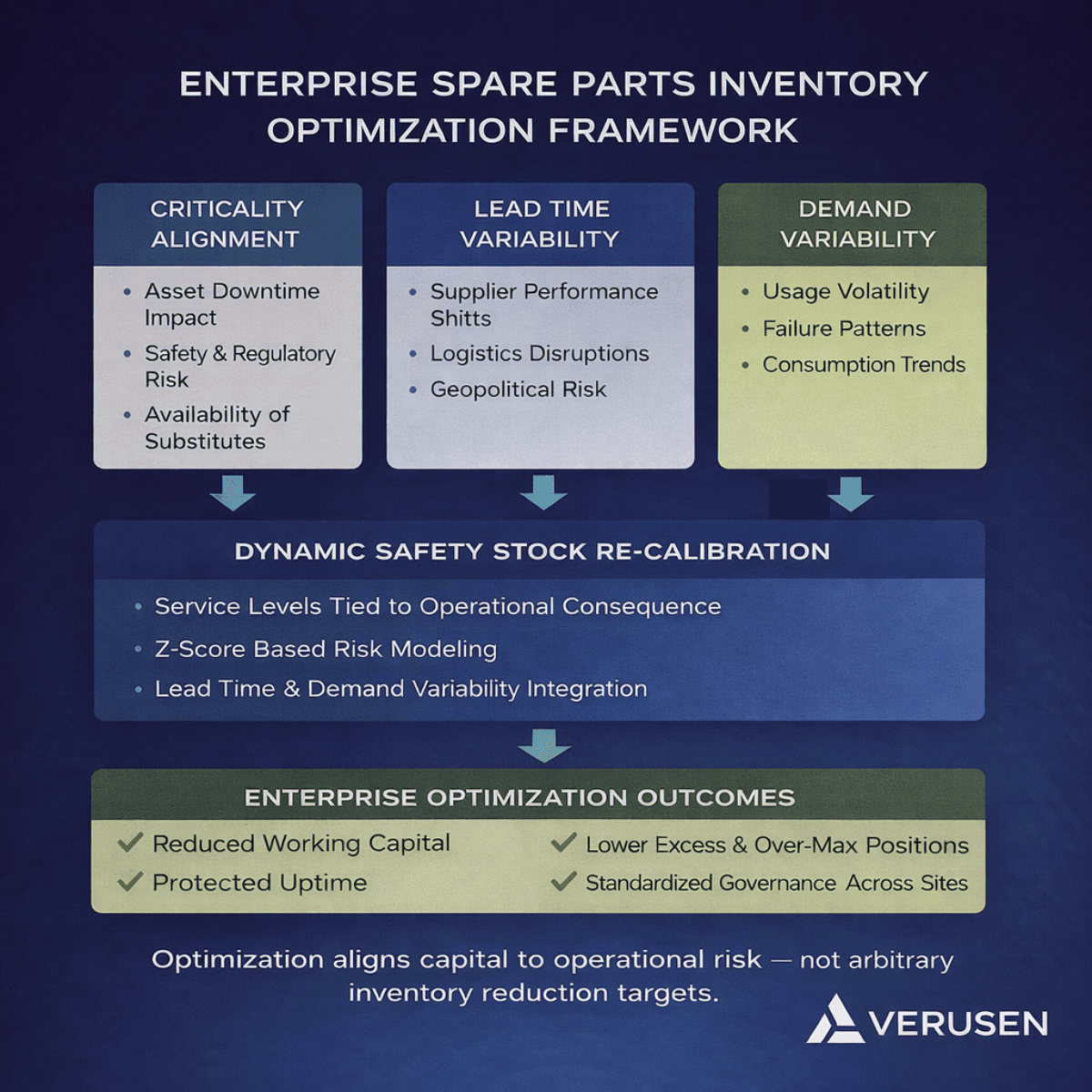
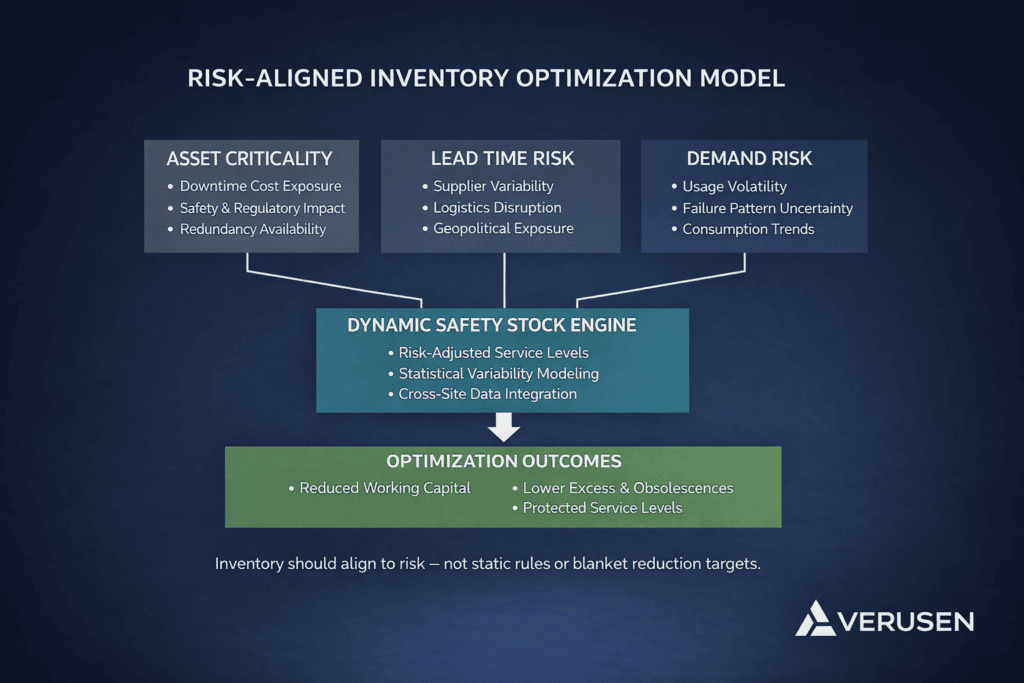
Spare parts inventory optimization is not about cutting stock. It is about aligning inventory to operational risk, lead time variability, and asset criticality so that capital is reduced without increasing downtime exposure.
For multi-site organizations managing millions in MRO inventory, the real question is not whether excess exists.
The question is whether you can identify it without creating hidden stockout risk.
If your organization wants to evaluate how much working capital could be optimized safely across your network, schedule a strategic assessment here.
This guide explains how enterprise spare parts inventory optimization works, why most ERP-based approaches fall short, and how organizations reduce capital exposure while strengthening uptime protection.
Why Traditional Spare Parts Inventory Optimization Fails
1 – Uniform Service Levels Create Capital Distortion
Many organizations apply a blanket service level target such as 95 percent across all spare parts.
This assumes that every part carries equal operational consequence.
In reality:
- A stockout on a low-value consumable may have minimal impact
- A stockout on a critical rotating asset component may shut down production
When service levels are uniform, non-critical inventory becomes overprotected while critical parts remain exposed.
True spare parts inventory optimization aligns service levels to operational impact.
2 – Static Lead Times Create False Security
ERP systems often rely on static lead time inputs.
But supplier performance shifts. Logistics disruptions occur. Geopolitical factors introduce variability.
If safety stock is calculated using outdated lead times, risk increases silently.
Safety Stock = Z-score × demand variability × √lead time
If lead time increases from 30 days to 90 days, safety stock requirements change materially.
Optimization requires dynamic recalibration of stocking policies.

3 – Local Optimization Undermines Enterprise Efficiency
Plants frequently optimize independently.
Site A may hold excess inventory “just in case” while Site B faces risk on identical materials.
Without unified visibility across sites:
- Duplicate inventory persists
- Cross-site pooling opportunities are missed
- Working capital remains inflated
Enterprise spare parts inventory optimization requires centralized analytical oversight.
The Enterprise Framework for Spare Parts Inventory Optimization
Step 1 – Harmonize Data Across Sites and Systems
Optimization begins with visibility.
Multi-site organizations must consolidate material data across ERP and EAM systems into a unified analytical view.
This enables:
- Cross-site inventory comparisons
- Duplicate spare parts identification
- Enterprise-level criticality alignment
Without harmonization, optimization efforts remain fragmented.
Step 2 – Reclassify Criticality Based on Operational Impact
Spare parts inventory optimization depends on accurate criticality classification.
Criticality should reflect:
- Asset downtime cost
- Safety implications
- Regulatory impact
- Availability of substitutes
If classification is inconsistent across sites, optimization will distort risk exposure.
Step 3 – Recalculate Safety Stock Using Dynamic Inputs
Stocking policies must account for:
- Lead time variability
- Demand variability
- Service level targets tied to consequence of failure
Example:
Assume:
- Annual demand variability supports a standard deviation equivalent to 10 units
- Z-score for a high-criticality part is 2.05
- Lead time increases from 30 to 60 days
Safety stock increases proportionally with the square root of lead time.
Failure to update this creates misalignment.
Optimization is not reduction for its own sake. It is recalibration.
Step 4 – Identify Excess and Over-Max Positions
Once criticality and safety stock are aligned, excess inventory becomes visible.
Common findings include:
- Overstock on non-critical items
- Inactive materials
- Redundant stock across sites
These represent working capital opportunity without increasing operational risk.
Step 5 – Establish Governance and Continuous Review
Spare parts inventory optimization is not a one-time exercise.
Governance requires:
- Standardized review workflows
- Cross-functional approval processes
- Ongoing lead time monitoring
- Executive-level reporting on capital and risk
If optimization is performed once and not revisited, drift returns.
Mid-initiative, if you want to validate whether your organization has hidden optimization opportunity, you can request a focused review here.
Financial Impact – Quantifying Safe Inventory Optimization
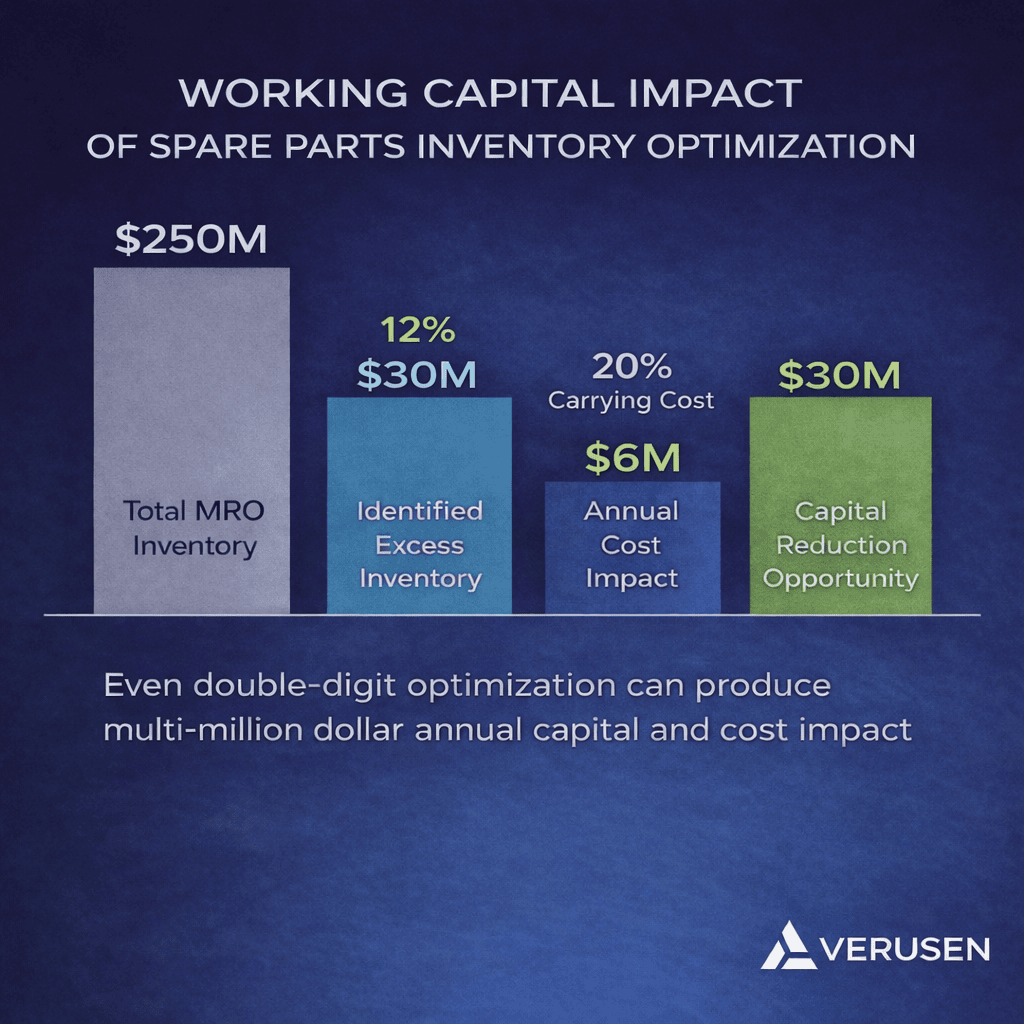
Consider a manufacturer with:
- $250 million in MRO inventory
- 20 percent carrying cost
Annual carrying cost = $250M × 20 percent = $50M
If enterprise spare parts inventory optimization identifies 12 percent excess inventory that can be safely reduced:
Inventory reduction = $250M × 12 percent = $30M
Annual carrying cost impact = $30M × 20 percent = $6M
This excludes avoided downtime.
If improved spare positioning prevents 48 hours of outage annually at $40,000 per hour, that represents an additional $1.92M in avoided impact.
Optimization must be evaluated against both capital and risk.
Case Study – Global Mining Organization Identified $96.8M in Inventory Opportunity Across 17 Sites
A global mining organization struggled with fragmented inventory decision-making across 17 operating sites.
Challenges included:
- No standardized parts criticality methodology
- Fragmented inventory data across multiple ERP systems
- Limited visibility into over-max positions and duplication
- Manual and inconsistent optimization efforts
Despite substantial inventory investment, the organization lacked enterprise-level alignment.
By implementing a unified, AI-driven MRO inventory optimization platform, the organization:
- Identified $96.8M in inventory opportunity across 17 sites
- Verified $550K in value within the first month of go-live
- Reviewed and optimized thousands of materials
- Identified $69M in parallel deployment value across 27 sites in UAT
The shift from local decision-making to enterprise governance enabled the organization to reduce excess inventory while strengthening confidence in spare availability for critical assets.
This is the essence of spare parts inventory optimization – reduce capital while protecting uptime.
FAQs
No. Enterprise environments rarely have perfect data. Harmonizing and analyzing existing ERP information is sufficient to identify excess, duplication, and risk exposure.
Not when performed correctly. Optimization aligns stocking policies to dynamic lead times and operational criticality, reducing excess non-critical stock while protecting mission-critical assets.
No. Enterprise spare parts inventory optimization platforms operate alongside existing ERP and EAM systems, unifying data without system replacement.
Organizations often identify significant inventory opportunity early in the process. Verified financial impact depends on implementation cadence and governance alignment, but visibility improvements surface quickly.
Conclusion
Spare parts inventory optimization is not about cutting inventory blindly.
It is about aligning capital to operational consequence.
When data is unified, criticality is standardized, and stocking policies are dynamically recalibrated, organizations reduce working capital while strengthening uptime protection.
If your enterprise operates multiple sites and has not performed enterprise-level spare parts inventory optimization, there is likely measurable opportunity. Schedule a strategic inventory optimization discussion here.