
Duplicate Spare Parts Across Sites: Why They Persist – And Why Most Fixes Fail

Introduction
Most multi-site manufacturers believe duplicate spare parts are a data problem – but treat them like a cleanup exercise.
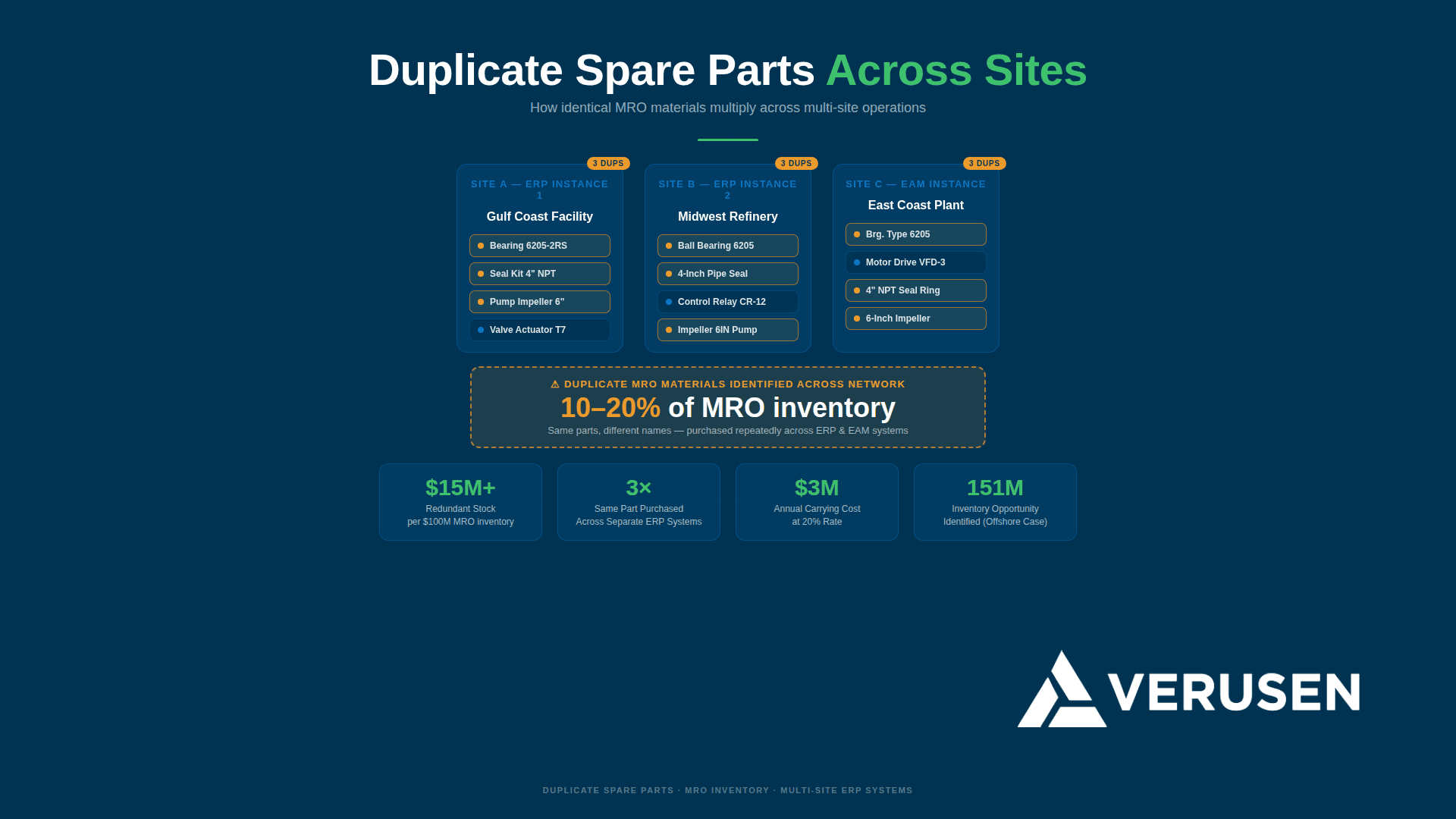
In environments with $100M or more in MRO inventory, 10–20% of materials are typically duplicates or near-equivalents. That means millions in redundant stock, ongoing repurchasing, and fragmented supplier spend.
The issue is not that duplicates exist. The issue is that most organizations attempt to fix duplication without addressing the underlying system, procurement, and decision-making constraints that create it.
Duplicate spare parts persist because inventory is managed locally, data is inconsistent across systems, and procurement operates without full inventory context.
If you want to eliminate duplication at scale, the focus has to shift from data cleanup to decision enablement.
Book a call with Verusen to identify duplicate materials across your network and quantify their financial impact.
Key Challenges and Solutions
Why Duplicate Spare Parts Persist in Multi-Site Environments
Duplicate materials are not random. They are the predictable result of how enterprise environments operate.
Common drivers include:
- Multiple ERP and EAM instances across sites
- Inconsistent naming conventions and descriptions
- Decentralized procurement decisions
- Lack of cross-site visibility
When each site operates independently, the same part can be created multiple times under different descriptions.
Over time, this creates:
- Redundant inventory across locations
- Increased working capital requirements
- Fragmented supplier relationships
Solution
Instead of relying on manual data standardization, organizations need AI-driven material intelligence that:
- Identifies equivalent and similar parts
- Connects fragmented records across systems
- Enables network-wide visibility
Why Data Cleanup Alone Fails
Many organizations attempt to solve duplication through data governance initiatives.
These efforts often include:
- Standardizing part naming conventions
- Cleansing material master data
- Implementing governance policies
While important, these approaches fail to deliver meaningful results because:
- They are slow and resource-intensive
- They do not prevent new duplicates from being created
- They do not translate into procurement or inventory decisions
Solution
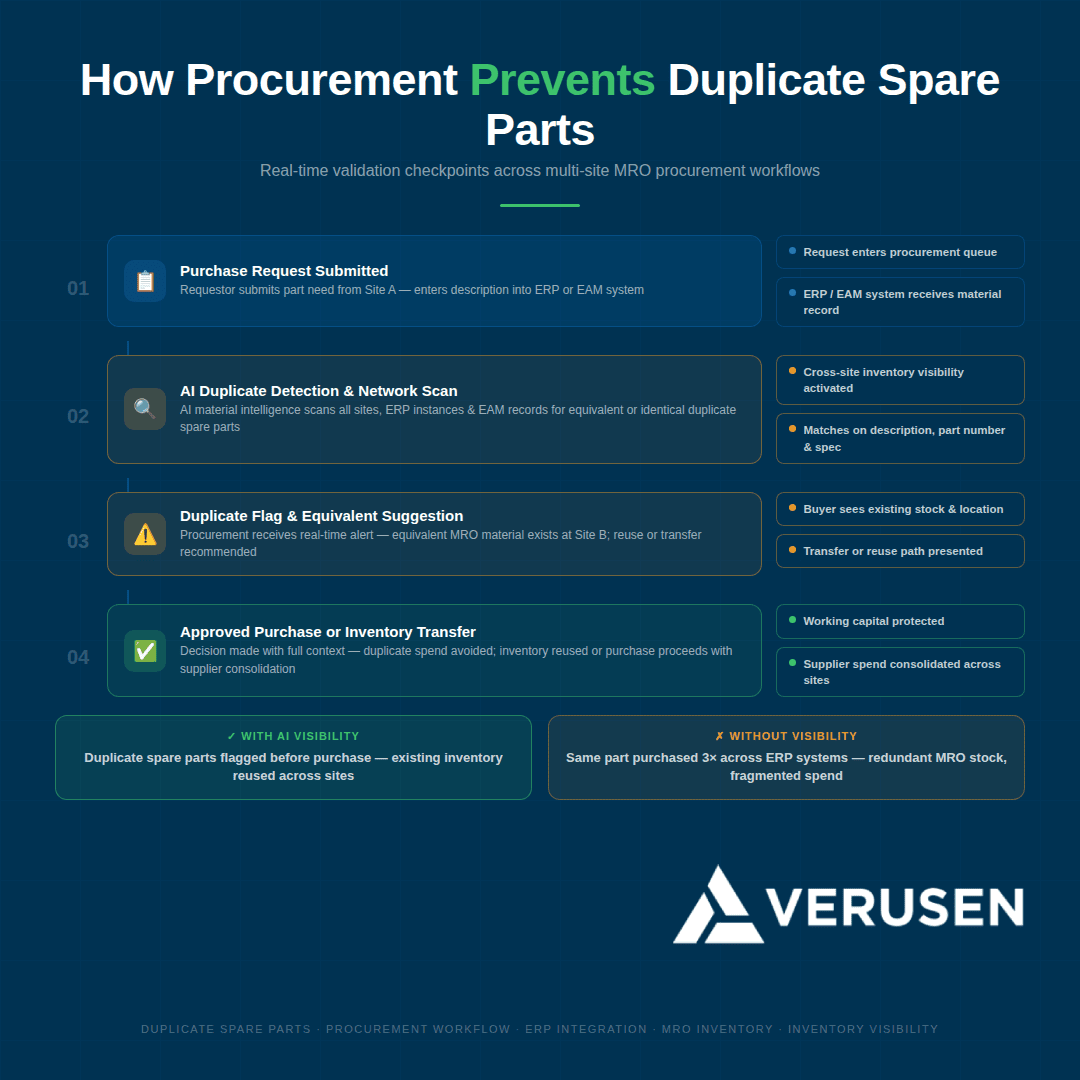
Effective duplication reduction requires integrating insights into workflows:
- Flagging duplicates during procurement
- Suggesting equivalent materials at the point of purchase
- Enabling reuse of existing inventory across sites
This shifts duplication from a data problem to a decision problem.
The Financial Impact of Duplicate Materials
Duplicate spare parts create both direct and indirect cost.
Direct impact includes:
- Redundant inventory investment
- Increased carrying costs
Indirect impact includes:
- Emergency purchases when equivalents are not recognized
- Supplier fragmentation and missed consolidation opportunities
- Increased storage and handling costs
Financial impact example
For a manufacturer with $100M in MRO inventory:
- 15% duplication = $15M in redundant stock
- 20% carrying cost = $3M annual cost
Additional hidden costs often exceed this baseline due to procurement inefficiencies.
Solution
Quantifying duplication is critical. Organizations that understand the financial impact can prioritize reduction efforts based on ROI, not assumptions.

Why Most Fixes Fail to Scale
Even when duplicates are identified, organizations struggle to eliminate them at scale.
Common reasons include:
- No ownership across procurement, engineering, and operations
- Lack of governance for material consolidation
- Inability to enforce standardized purchasing behavior
This results in a cycle where duplicates are identified, partially addressed, and then recreated.
Solution
Sustainable duplication reduction requires:
- Cross-functional governance
- Integration into procurement workflows
- Continuous monitoring and enforcement
This ensures that duplication is not just reduced once, but prevented over time.
Book a call with Verusen to see how duplicate materials can be identified, quantified, and eliminated across your entire network.
Case Study: Offshore Oil & Gas Operator (17 Rigs)
An offshore oil and gas operator managing 17 rigs faced significant challenges with duplicate spare parts across its fleet.
Their environment included:
- Independent inventory systems across rigs
- Inconsistent material descriptions
- Limited visibility into equivalent parts
This led to repeated purchasing of materials that already existed elsewhere in the network, increasing both cost and operational risk.
After implementing a material intelligence and inventory optimization solution, the organization achieved:
- $151M in identified inventory opportunity
- Significant reduction in duplicate materials
- Improved cross-rig inventory visibility
The transformation was driven by:
- Identification of equivalent and duplicate parts across systems
- Enablement of inventory sharing between rigs
- Integration of insights into procurement workflows
As a result, procurement decisions shifted from isolated, reactive purchasing to coordinated, data-driven execution.
FAQs
Because duplication is driven by system fragmentation and decentralized decision-making. Without integrating controls into procurement and inventory workflows, new duplicates will continue to be created.
Yes. Modern solutions work across existing ERP and EAM systems, identifying equivalents and enabling better decisions without requiring system replacement.
They increase unnecessary purchases, fragment supplier spend, and reduce negotiating leverage. Eliminating duplicates improves procurement efficiency and cost control.
Organizations can begin identifying duplicates within weeks and realize measurable financial impact within the first few months, depending on scale and adoption.
Conclusion
Duplicate spare parts are not just a data issue. They are a structural outcome of how multi-site manufacturing environments operate.
Organizations that succeed move beyond cleanup initiatives and embed intelligence into procurement and inventory decisions.
To understand how much duplication exists in your environment and what it is costing you, book a call with Verusen and evaluate your inventory across all sites.